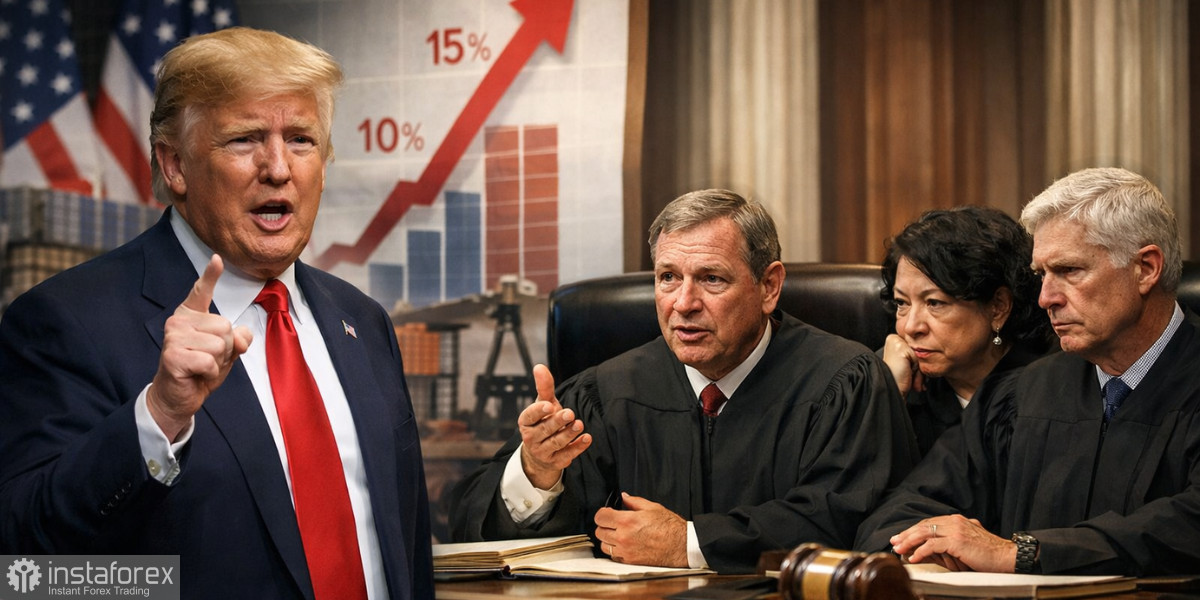
Donald Trump raised tariffs to 15%, but the US Supreme Court questioned their legality
Donald Trump announced plans to raise import tariffs for a number of countries from 10% to 15%, saying his policy is aimed at eliminating threats, including those related to Iran's nuclear program. The escalation of protectionist rhetoric increases the risk of a new wave of trade conflicts and may affect commodity markets. The oil and metals sectors are likely to come under the greatest pressure because of their sensitivity to international trade and sanctions.
Additional uncertainty was created by the US Supreme Court's ruling that found the imposition of the tariffs unlawful and limited the executive branch's powers in this area. This creates a legal vacuum for importers and complicates the process of reclaiming duties already paid — the total disputed amount could reach $200 billion. Markets are reacting to the news with sharp impulses and wider ranges. Use InstaForex tools to trade in such conditions. More details via the link.
Bitcoin loses momentum: $3.8bn exited ETFs as stablecoins grow
The leading cryptocurrency is facing growing competition from stablecoins, which are showing steady market-cap growth and gradually siphoning off liquidity. Against this backdrop, interest in Bitcoin is falling: roughly $3.8 billion has flowed out of BTC-focused ETFs. This indicates a shift in preferences among some institutional investors who are seeking more predictable instruments amid market turbulence.
Reduced capital inflows into Bitcoin ETFs weaken price support and increase the likelihood of a deeper correction in the absence of new growth drivers. In the short term, dynamics will depend on overall risk appetite and Fed policy, as the crypto market remains sensitive to dollar liquidity. More details via the link.
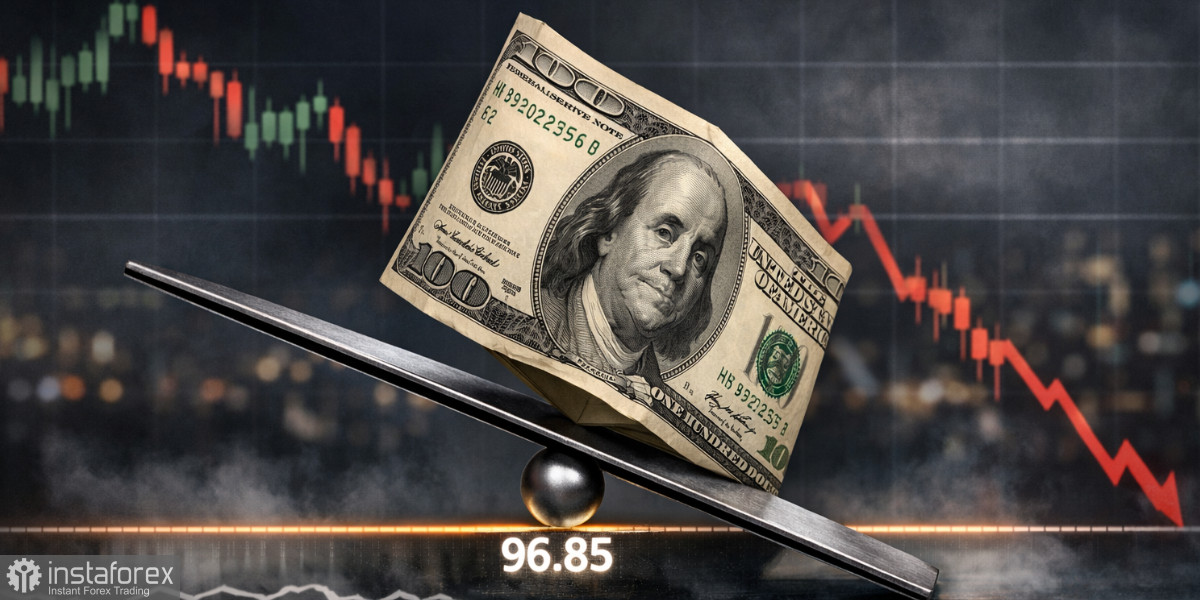
Dollar index hovers at key levels: a break of 96.85 would increase pressure
The US Dollar Index is showing mixed dynamics without a clear trend. Market participants are taking a wait-and-see stance ahead of fresh signals from the Fed that could set the course for FX markets. The lack of clear directional cues heightens the importance of technical levels around which liquidity concentrates.
The 96.85 mark is viewed as an important support: a break below it could trigger the formation of a sustained bearish trend for the dollar. In such a scenario, pressure could intensify both against the euro and against emerging market currencies. Heightened sensitivity to macro data and central bank commentary makes the current phase especially active in terms of intraday swings. More details via the link.
AI and capital rotation amplify turbulence: the market recalls dot-com lessons
The US equity market is experiencing notable volatility amid active capital rotation and a reassessment of AI's impact on the economy. On one hand, AI is seen as a powerful productivity driver; on the other, concerns are rising about potential large-scale layoffs as early as next year. These risks are forcing investors to revise long-term earnings expectations and assess the resilience of consumer demand.
Fears about structural labor market shifts and excessive valuations in tech are increasingly compared to the conditions that preceded the dot-com crisis. Sharp price swings reflect the tug-of-war between faith in a new tech cycle and fear of overheating. In these conditions the market becomes especially sensitive to corporate earnings and management commentary. More details via the link.
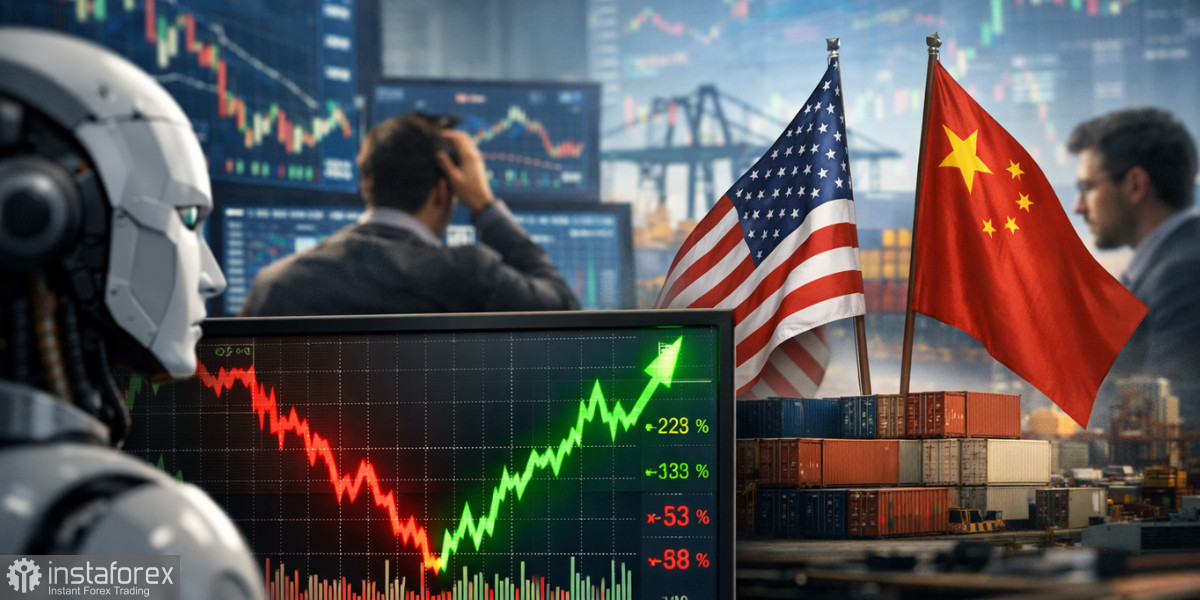
After "Black Monday", stock indices bounce, AI and trade-war risks remain
After the sharp sell-off dubbed "Black Monday," US equity indexes have moved into a cautious recovery. However, this rebound looks more technical than fundamentally driven: uncertainty over AI's evolution and the potential resumption of trade conflicts continues to weigh on investor sentiment.
Large companies, including IBM and American Express, have already felt negative effects from accelerated AI adoption, which has impacted their share prices and influenced index dynamics overall. The market is balancing between attempts to stabilize and the risk of a new wave of sell-offs, so reactions to news remain sharp and short-lived — periods of heightened amplitude that present opportunities for flexible trading in indices and stocks using InstaForex instruments. More details via the link.